
Heavy Truck Body Shop Alternatives: A Guide to Fleet Collision Management
- Alina Rikli
- 4 days ago
- 11 min read

The standard auto body shop down the street wasn't built for your fleet's heaviest assets. When a high-roof van or a coach bus sustains damage, sending it to a general repair network often results in weeks of preventable downtime. You need more than just a local fix; you need a facility that can handle the structural complexity of commercial equipment. Successfully choosing a fleet collision repair partner means finding a specialist who understands that an idle truck is a liability, not just a project.
We understand the frustration of seeing a specialized vehicle sidelined by poor paint matching or a shop's lack of large-scale infrastructure. You deserve a partner that treats your downtime with the same urgency you do. This guide explores why specialized heavy-duty facilities outperform general networks for oversized repairs and how to identify a reliable long-term ally for your fleet. We will cover the technical demands of fiberglass restoration, the implications of the 2026 FMCSA mechanic signature requirements, and the specific strategies used to reduce repair cycle times for specialized assets.
Table of Contents
Why Standard Auto Body Shops Aren’t Real Alternatives for Heavy Trucks
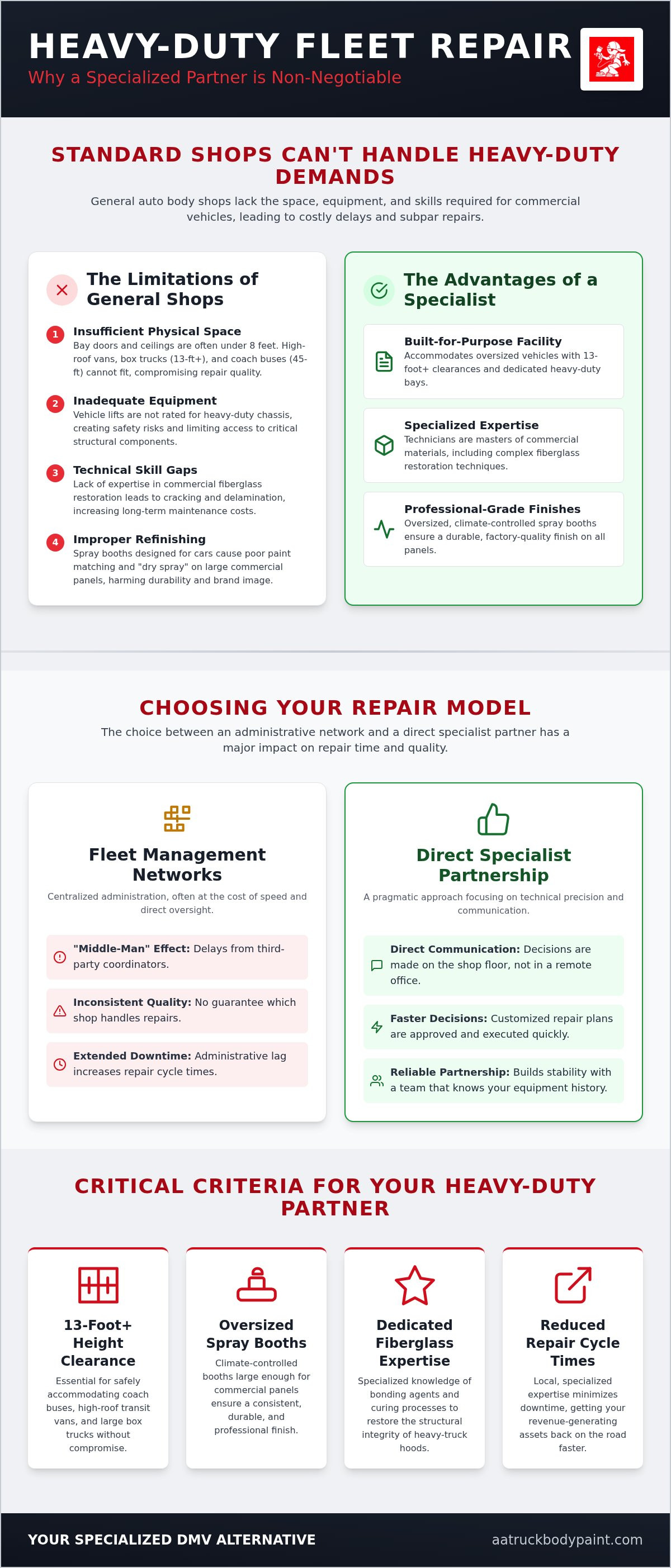
Many fleet managers assume a high-quality local body shop can handle their entire inventory. While Standard Auto Body Shops excel at repairing sedans and light SUVs, they lack the specialized infrastructure required for heavy assets. Successfully choosing a fleet collision repair partner involves recognizing that heavy truck repair is its own distinct discipline. A shop designed for passenger cars simply isn't equipped for the scale and complexity of a Class 8 vehicle or a coach bus.
The Physical Limitations of General Shops
The most immediate barrier is physical space. Most general shops operate with bay doors and ceiling heights designed for vehicles under eight feet tall. High-roof Ford Transit or Mercedes Sprinter vans often exceed these clearances. If a facility can't comfortably house a 13-foot high box truck or a 45-foot coach bus, the repair quality suffers. Technicians end up working in cramped conditions or, in some cases, performing parts of the job in environments where dust and debris ruin the finish. Standard vehicle lifts also have weight capacities that aren't rated for the heavy-duty chassis of a commercial asset, creating safety risks and limiting access to the vehicle's structural components.
Technical Skill Gaps in Non-Specialized Facilities
Commercial vehicles utilize materials and coatings that require specific expertise. While a general technician is an expert in automotive sheet metal, commercial truck fiberglass restoration is a specialized trade. Heavy-truck hoods and fairings are often made of reinforced fiberglass that demands unique bonding agents and curing processes. Using passenger-car fillers or standard automotive techniques on these panels leads to cracking and delamination over time, which increases your long-term maintenance costs.
Refinishing is another area where general shops struggle. Large commercial panels require oversized, climate-controlled spray booths to ensure a consistent finish. When a shop tries to paint a large box truck in a booth designed for a sedan, the airflow is restricted. This results in poor paint matching, "dry spray" textures, and a finish that won't stand up to the rigors of high-mileage commercial use. Choosing a fleet collision repair partner with the right equipment ensures your brand's image remains professional and your assets stay durable on the road.
Comparing Fleet Collision Management Networks vs. Specialist Shops
When you begin the process of choosing a fleet collision repair partner, you'll likely encounter two distinct models: national management networks and independent specialist shops. It's a fundamental choice between administrative convenience and technical precision. National networks, such as Element or Fleet Response, act as intermediaries. They provide a centralized platform for billing and reporting, which appeals to multi-state fleets with thousands of units. However, this convenience often comes at the expense of direct communication and repair speed.
The Network Management Model
The network model prioritizes volume and standardized data. While centralized reporting is a benefit for corporate accounting, the "middle-man effect" can complicate the actual repair. When a claim moves through a management layer, every supplement and approval must pass through a third-party coordinator who may never see your vehicle in person. This administrative lag often extends vehicle downtime. You aren't just waiting on parts; you're waiting on a corporate bureaucracy to process paperwork. Furthermore, networks don't always guarantee which specific shop will handle your heavy truck, leading to inconsistent quality across different regions.
The Direct Specialist Partnership
A direct partnership with a specialized facility offers a more pragmatic approach. Decisions happen on the shop floor, not in a remote office. This direct line of communication is essential for specialized assets like RVs and motorhomes. These vehicles require customized repair plans that standard network protocols often overlook. By working directly with a specialist, you ensure that the technicians understand the specific structural needs of your fleet. This relationship builds a sense of stability, as you have a reliable long-term partner who knows the history of your equipment and the urgency of your delivery schedules.
The cost implications also differ significantly. Management networks often involve additional fees for their software and coordination services. In contrast, a specialist shop focuses its value on the craftsmanship of the repair itself. According to 2026 industry data, the median labor rate for heavy-duty repair shops is $149 per hour. In a specialist environment, that investment goes directly toward technical mastery and reducing cycle times. Choosing a fleet collision repair partner that offers direct access to expertise ensures your budget is spent on quality restoration rather than administrative overhead. This directness is especially valuable for DMV-based fleets that need a dependable local anchor for high-stakes repairs.
Mobile Repair vs. Dedicated Heavy-Duty Facilities
The rise of mobile repair services offers a tempting proposition for busy fleet managers: on-site fixes with zero transport time. While this model works for small-scale aesthetic issues, it cannot replace the specialized environment of a dedicated heavy-duty facility. When you're choosing a fleet collision repair partner, it's vital to distinguish between a quick cosmetic touch-up and a structural restoration that ensures vehicle safety and longevity.
When Mobile Repair is an Option
Mobile body repair is a pragmatic choice for minor fleet maintenance. It’s effective for small paint scuffs that maintain branding consistency or repairing non-structural plastic components on a bumper. These services are also useful for performing on-site estimates. A technician can visit your yard in Lorton or anywhere in the DMV to determine if a vehicle is road-legal or if it requires a tow to a specialized facility. If the damage is limited to a surface-level scratch that won't lead to corrosion, mobile repair is a functional, low-cost solution.
Why Major Repairs Demand a Dedicated Facility
Structural integrity and high-quality refinishing require a controlled environment that a parking lot simply cannot provide. Major collisions often involve frame misalignment. Correcting this requires heavy-duty frame straightening equipment anchored into the shop floor. Attempting to pull a heavy-truck frame without industrial-grade machinery is unsafe and often results in a vehicle that's impossible to align properly. This leads to premature tire wear and handling issues that increase your long-term operating costs.
Environmental control is another critical factor. Professional commercial painting, especially heavy-truck hood painting, requires a pressurized, dust-free spray booth. Painting outdoors or in an open bay exposes the wet finish to wind, debris, and temperature fluctuations. This leads to "orange peel" textures or trapped contaminants that compromise the paint's durability. For oversized assets, the requirements are even stricter. A specialized coach bus body shop virginia facility provides the necessary height and length to house 45-foot vehicles in a climate-controlled booth. This ensures a factory-quality finish that stands up to the 2026 FMCSA vehicle maintenance standards, where visual defects now carry higher severity weights in CSA scoring. Choosing a fleet collision repair partner with a dedicated facility is an investment in the long-term safety and resale value of your specialized assets.
Critical Criteria for Evaluating Heavy Truck Body Shop Alternatives
When you shift your focus from general auto repair to heavy-duty specialists, your evaluation process must change. Standard certifications, while useful for passenger cars, don't account for the unique stresses of commercial operation. Successfully choosing a fleet collision repair partner requires a pragmatic look at a shop's physical capacity and technical history. You need a facility that is built for the scale of your assets, not one that treats a box truck as an oversized car.
Oversized Facility Requirements
The most basic criterion is clearance. You must verify that the shop can physically accommodate a 13-foot high box truck or a 45-foot coach bus without compromising safety. This extends to the refinishing stage. Professional results depend on oversized spray booths, typically 40 to 50 feet in length, which provide the necessary airflow for large-scale painting. If a shop lacks these specialized booths, they can't guarantee a durable finish that resists the peeling and fading common in high-mileage fleets. Additionally, check for heavy-duty towing partnerships. Since standard tow trucks cannot handle a non-drivable Class 8 vehicle, a reliable partner should have established connections with heavy-recovery services to streamline the intake process.
Commercial Repair Standards
Technical proficiency in this field is highly specific. You should look for a partner with documented experience in box truck panel restoration and corner cap replacement. These components aren't found on passenger vehicles, and improper installation leads to water leaks that ruin cargo. Precision paint matching is equally vital. Commercial fleet colors often age differently than automotive finishes; a specialist understands how to blend new coatings with existing fleet branding to maintain a uniform look across your inventory.
Fiberglass expertise is another non-negotiable factor. Heavy-truck hoods are complex structural components, and a dedicated repair area for fiberglass ensures that dust from sanding doesn't contaminate the rest of the shop. Finally, prioritize a partner that understands the financial impact of downtime. A specialist shop focuses on return-to-service timelines because they know an idle truck costs you revenue every day it sits. If you are looking for a facility that meets these rigorous standards in the DMV area, contact our specialized team to discuss your fleet's specific needs. We focus exclusively on commercial assets, ensuring your insurance claims and repairs are handled with industry-specific proficiency.
The Specialized DMV Alternative: AA Truck Body & Paint
AA Truck Body & Paint has spent over 30 years refining a specialized approach to heavy truck collision management. We serve the Maryland, Virginia, and DC area with a single-minded focus. Unlike general shops that split their attention between consumer cars and commercial accounts, we exclusively handle commercial and oversized vehicles. This specialization ensures that our facility, equipment, and technicians are always ready for the specific demands of heavy-duty assets. We aren't a generalist shop trying to fit a truck into a car-sized workflow.
Our expertise covers the entire spectrum of fleet body and paint needs. We provide specialized fiberglass repair for heavy-truck hoods and precision refinishing for high-roof transit vans. Every project we take on is managed with a pragmatic, professional mindset. We understand that your vehicles are revenue generators. Our goal is to provide a reliable, long-term partnership that prioritizes both structural integrity and aesthetic quality. When you are choosing a fleet collision repair partner, you deserve a team that speaks your language and understands your operational pressures.
Serving the Northern Virginia and DMV Fleet Community
Located in Lorton, VA, our facility is strategically positioned for regional fleet access. We take a straight-shooter approach to every interaction. You need honest timelines and accurate estimates to keep your business moving. We provide clear communication to help lower the stress levels associated with high-stakes repairs. Our presence in the community for three decades has built a foundation of trust with local logistics providers and transit agencies. We act as a professional ally, ensuring your specialized assets are in safe hands.
Next Steps for Your Fleet
Initiating a professional commercial truck collision estimate is a straightforward process. When you contact our Lorton facility, we focus on the technical details that matter for oversized vehicles. To prepare your vehicle for service, ensure that all cargo is removed and internal compartments are secured. This allows our technicians to access structural panels and fiberglass components efficiently. It also ensures the safety of your equipment during the restoration process.
We invite you to contact us for oversized vehicle consultations or to discuss long-term fleet maintenance plans. Whether you manage a fleet of coach buses or a delivery network of high-roof Sprinter vans, we have the infrastructure to support you. Successfully choosing a fleet collision repair partner is a decision that impacts your operational uptime. We are ready to demonstrate the value of 30 years of specialized expertise in the heart of the DMV.
Securing Your Fleet’s Operational Future
Managing a commercial fleet requires a shift away from generalist solutions toward specialized technical expertise. You've seen that standard auto body shops and administrative networks often lack the physical infrastructure and direct communication needed for high-stakes repairs. Successfully choosing a fleet collision repair partner means prioritizing facilities with oversized spray booths and specific fiberglass capabilities that can handle the structural demands of your heavy-duty assets.
At AA Truck Body & Paint, we bring 30+ years of industry experience and local expertise to every project. Our Lorton-based facility is built exclusively for oversized vehicles, ensuring your high-roof vans, coach buses, and heavy trucks receive the precision care they deserve. We are dedicated to reducing your downtime and restoring your equipment to professional standards. To begin your restoration process, Get a Professional Commercial Truck Collision Estimate from our specialized team today. We look forward to being the reliable, long-term partner your business can depend on for years to come.
Frequently Asked Questions
What makes a heavy truck body shop different from a standard collision center?
A heavy truck body shop is defined by its specialized infrastructure, such as oversized spray booths and high-clearance bay doors that accommodate vehicles over 13 feet tall. Standard collision centers focus on passenger cars and lack the industrial-grade equipment needed for Class 8 frames. Choosing a fleet collision repair partner with these dedicated capabilities ensures that your commercial assets are restored with the structural integrity required for heavy-duty operation in the DMV.
Can any fleet collision repair company handle oversized coach buses?
No, only facilities with specific oversized capabilities can safely handle a 45-foot coach bus. These vehicles require a shop with significant floor space and specialized towing partnerships for non-drivable units. Many general fleet shops lack the vertical clearance for high-roof shuttle buses. At our Lorton facility, we focus on these large-scale assets, providing the specialized environment necessary for complex coach and shuttle bus body repair across Virginia and Maryland.
Why is fiberglass repair so important for commercial truck fleets?
Fiberglass repair is critical because most modern heavy-truck hoods and aerodynamic fairings are constructed from reinforced composite materials. Unlike automotive sheet metal, fiberglass requires specific bonding agents and climate-controlled curing to prevent future cracking or delamination. Professional fiberglass restoration maintains the structural durability of your fleet. This expertise is a key factor when choosing a fleet collision repair partner, as improper techniques can lead to costly repeated repairs.
How does downtime at a body shop affect my fleet’s bottom line?
Extended downtime directly translates to lost revenue and increased operational costs for your business. Every day a specialized asset sits in a shop, it's failing to generate income while potentially causing missed delivery windows or driver scheduling conflicts. We prioritize efficient cycle times at our DMV facility because we understand that reducing downtime is just as important as the quality of the physical repair itself for busy commercial professionals.
Do I need a national management network for a small commercial fleet?
Small commercial fleets often benefit more from a direct relationship with a local specialist than a national management network. While networks provide centralized reporting for massive corporations, they often add administrative layers that delay repairs. A local partner in the DMV offers faster decision-making and a more pragmatic approach to your specific fleet needs. This direct line to the technicians performing the work ensures your repairs are handled with personal accountability.
What should I look for in a heavy-truck hood painting service?
Look for a provider that utilizes pressurized, oversized spray booths to ensure a contaminant-free finish on large panels. Precision paint matching is also essential, as commercial fleet colors must remain consistent across your entire inventory to protect your brand image. A dedicated facility will have the environmental controls necessary to apply durable, high-quality coatings that stand up to the rigorous mileage and environmental exposure typical of heavy-duty commercial trucking.
Is it better to use a local specialist or a national repair network?
Choosing a local specialist is generally the better option for fleets that value technical precision and direct communication. National networks prioritize volume and often act as administrative intermediaries, which can lead to quality variance between different shops. A local specialist in Lorton provides a stable, long-standing presence and a deep understanding of the local operational pressures you face. This partnership fosters trust through consistent craftsmanship and predictable repair timelines for your specialized assets.
Does AA Truck Body & Paint handle mechanical engine diagnostics?
No, AA Truck Body & Paint focuses exclusively on body and paint restoration for commercial and oversized vehicles. We do not provide mechanical engine diagnostics or repair services. By specializing strictly in collision work, fiberglass restoration, and professional refinishing, we ensure our facility and staff maintain the highest standard of aesthetic and structural craftsmanship. This focus allows us to be a dedicated partner for fleet managers who need expert-level bodywork in the DMV area.


Comments